A Texas mother is fighting for answers she’s been chasing for more than a decade. She now believes that one of the preserved bodies displayed in the popular “Real Bodies” exhibit belongs to her son — and she refuses to let the matter rest until DNA testing is performed.
Back on November 10, 2012, 23-year-old Chris Erick was found lifeless in his bed at his grandmother’s home in Midlothian, Texas. Police told his mother, Kim Erick, that her son had died quietly in his sleep. According to their initial explanation, Chris had suffered two heart attacks caused by an undiagnosed heart condition. The case seemed closed before she was even given a chance to grasp what had happened.
Two days later, she viewed his body at a funeral home. Without consulting her, Chris’s father and grandmother arranged for him to be cremated soon afterward. She was handed a necklace containing what she was told were some of his ashes — an act that left her feeling pushed aside during the most painful moment of her life.
But something about his death never sat right with her.
Once she received the police scene photographs, her unease grew into certainty. The images, she said, showed bruises, lacerations, and what looked like restraint marks across her son’s chest, abdomen, and arms — marks she believed were far too extensive to dismiss as unrelated. Even more disturbing, she said she noticed what appeared to be a powdery residue around his lips that she believed resembled cyanide.
She shared her fears publicly, writing that she believed something horrific had occurred in that room. Her post was emotional, graphic, and desperate — the voice of a mother convinced her son had been harmed.
Her persistence led the Dallas County Medical Examiner to revisit Chris’s case roughly a month after his death. A preserved vial of his blood was tested. The results changed everything. The toxicology report revealed lethal levels of cyanide in his system. His cause of death was officially revised to cyanide toxicity, and the manner of death updated to “undetermined.”
It was a vindication she never wanted, but one she had expected.
Still, doors kept closing. In 2014, Ellis County brought the case before a grand jury as part of a murder investigation, but the panel declined to issue any charges. Officials continued to rule the death as a suicide by undetermined means. For Erick, that outcome felt like yet another dismissal.
She insisted that something was being hidden — that answers were being carefully kept out of her reach.
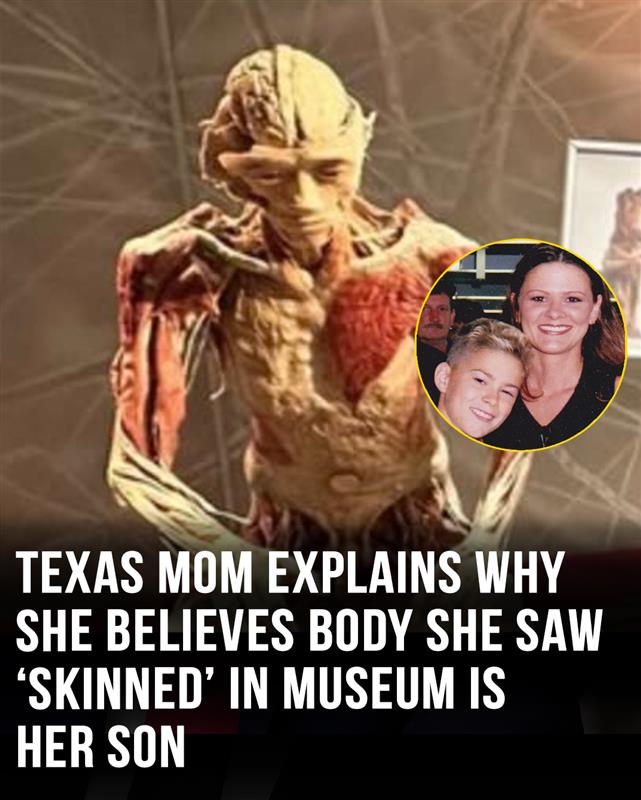
Driven by grief and a stubborn resolve, she continued her own investigation. One feature she focused on was a skull fracture found on the right side of Chris’s head. While looking through publicly available materials online, she came across Real Bodies, a well-known traveling exhibit that uses plastination to preserve human cadavers.
It was there — among dozens of posed anatomical figures — that she saw one that stopped her cold.
The figure, labeled “The Thinker,” appeared to have the same fracture in the same location. She also noticed that the area where her son had a tattoo had been cut clean, which she interpreted as an attempt to remove identifying marks. Combined with what she described as physical similarities, the resemblance felt too strong to ignore.
Seeing those images, she later said, was like being forced to relive her son’s death in a way she never imagined. The shock of it — the idea that she might be looking at her son’s preserved, dissected body on public display — left her devastated.
With that discovery, she went public again, sharing comparison photographs and pleading for answers. She demanded that the exhibit allow a DNA test on the figure so she could be certain.
Organizers rejected the request. They stated the body had been legally sourced in China more than two decades earlier — well before Chris’s death — and insisted there was no factual basis for her claim. They expressed condolences but maintained their position.
But then something happened that only fueled her suspicions further.
Shortly after her allegations gained traction, the specific figure she identified — “The Thinker” — quietly disappeared from the Las Vegas exhibit. She learned it had been moved to Union City, Tennessee, but after that, she could no longer trace it. The sudden removal, with little explanation, only deepened her belief that she was being shut out of the truth.
She made it clear that she wasn’t giving up. She said she would continue searching for answers because her son deserved not to be forgotten in death any more than he was in life.
In July 2023, when more than 300 piles of unidentified cremated remains were discovered abandoned in the Nevada desert, Erick once again raised concerns. She urged investigators to test them for traces of plastination compounds — anything that might help her determine whether her son’s remains had somehow ended up far from where she believed they should be.
Her mission now stretches far beyond a single claim. It has become a fight against the idea that any family should be left with only questions. She says she wants the truth, whatever it is, and she hopes no other parent ever has to walk this impossible road alone.
What do you think about this case? Feel free to share your thoughts before passing the story along.